

Magdalena Bay
%2014_58_14.png)
"Patience will get you your turn"
Alonso I. Rodríguez de la Parra, explorer and documentary filmmaker.
%207_18_56.png)
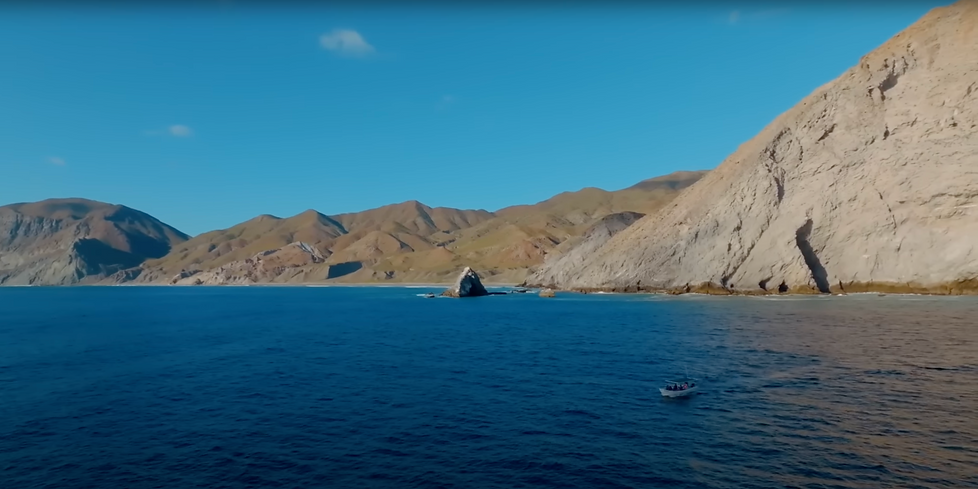
Bird Island in Magdalena Bay
Magdalena Bay.
Sailing in Magdalena Bay can evoke a multitude of emotions. As we know, the ocean isn't a zoo; you can't take anything for granted. In a single day, you might have hundreds of encounters, but you might also see nothing at all. Whenever I venture out to sea, I have no expectations in mind; most of the time, I'm simply grateful for the opportunity to witness a new sunrise.
Yes, sunrises are the natural events I enjoy most. I can safely say that 99% of sunrises are beautiful. Simply witnessing that light painting everything around us with magical colors is enough to fill you with joy. And if you add to that the experience of setting sail, feeling the breeze and the water being cut by the bow of the boat, then that's reason enough to feel gratitude.
It is light that makes all this wonder possible.
%207_18_07.png)
Sunrise in the Bay - Alonso I. Rodríguez de la Parra
When you set out on the ocean without expectations, there's always something that will surprise you. And often, what has impressed me most is simply being in the boat, contemplating the scenery or waiting for something to happen. The waiting time leads you to reflect on questions that align with many existential doubts. These thoughts arrive with the breeze, without the distractions of a cell phone, since most of the time there's no signal. These are moments I cherish immensely.
It's like entering a meditative state where the sea provides the answers you need to heal aspects of your life. I think this is something many of us who regularly go out to the ocean can relate to. The sea opens our minds and allows us to think more clearly. There's something about it that makes us more sensitive; its grandeur shows us how small we truly are.
%207_17_03.png)
Sailing in Paradise - Alonso I. Rodríguez de la Parra
The bay stretches approximately 50 km along the western coast of Baja California Sur, sheltered by the sand islands of Magdalena and Margarita. It belongs to the municipality of Comondú and is primarily visited due to the gray whale migration, a spectacle I have yet to have the pleasure of witnessing. These majestic creatures arrive in winter to breed.
Although I'm not personally a fishing enthusiast, this place is frequented by many sport fishermen. However, I don't entirely agree with this practice, as in recent years it has been shown that much more sustainable tourism, such as marine wildlife viewing, can benefit the area far more than activities considered extractive. From my first visit to my most recent one, I've noticed a significant increase in the number of fishing boats and a decline, and even migration, of species to other, less crowded areas.
Without a doubt, whale watching tourism can be extremely beneficial for the area if we continue to regulate it, promote good practices and, above all, transmit to the people who accompany us on these excursions a culture of well-being and a healthy relationship with the environment and the ocean.

Companions from my first visit to the Bay (2019) - Alonso I. Rodríguez de la Parra
Throughout the year, you can spot different species in this area. I dare say that all of Baja California is, without a doubt, a paradise for biodiversity. As a society, we should be more aware of the need to take greater care of these places with which we interact: whether as tourists, service providers, or fishermen. But, even more importantly, we must recognize that, even if we are not physically present here, the whole world is connected, and our actions from home will also have an impact on places like this.
Therefore, it is essential that when we visit these natural sanctuaries, we not only take away memories, but also stories that we can share with others. But above all, we must convey the importance of what lies beyond our immediate surroundings, in those natural spaces that not many have the opportunity to see.


Sharing messages about nature and life - Photographer unknown
I firmly believe that all species, including humans, have a greater purpose in this life and are capable of conveying far more than what our eyes can see or our mouths can express. There is a type of communication that is little known and rarely discussed; it is more related to the capacity to feel than to the capacity to understand or comprehend. When nature presents itself to us, it goes far beyond simply being lucky; countless factors come into play that allow you to be in the right place at the right time.
I know many people who have visited these places and never had a meaningful encounter. That's why I greatly appreciate the opportunity to observe smaller species that may not be as celebrated as the larger ones. You can call me a romantic or whatever you like, but I firmly believe that every species has a lesson to teach us. One can find lessons everywhere if one observes enough, but above all, if one is open to feeling.

Sardine fungus - Alonso I. Rodríguez de la Parra
Every autumn, the currents of the Pacific Ocean bring with them the famous bait balls of sardines or mackerel, unleashing a mesmerizing natural spectacle. Watching these schools of fish move in an underwater ballet is like witnessing a perfectly orchestrated symphony with unpredictable variations. These congregations form figures in the water that, with a little imagination, can take on almost any shape you can imagine. It's a feeling similar to when we were children and looked for shapes in the clouds. It's the power of cooperation and interdependence in nature. It often seems that we humans are the only ones out of sync with everything else that exists.
These bait balls attract hundreds of species, filling the waters of these coasts with food and abundance. Among these species are orcas, various whale species, marlin, tuna, mahi-mahi, sharks, sea lions, dolphins, biologists, tourists, and influencers. It's impressive how a species that isn't widely discussed generates a whole chain of visits, interconnections, and relationships that transcend the simple act of being there. For us humans, it's a memory that lasts a lifetime.

Marlins feeding - Alonso I. Rodríguez de la Parra
The blue-striped marlin is one of the most beautiful fish I've ever had the privilege of witnessing swimming. It glides through the water with impeccable skill, being the fastest fish in the ocean. Observing its elegance in this way is something that remains etched in my mind forever—not just the image, but also the feeling; an indescribable energy.
They have such incredible control over their bodies that they display astonishing precision in their pursuit of their target. This leads me to believe that, if a marlin wanted to, it could take down any one of us. There are records of accidents involving fishermen being impaled by a marlin's bill as they leap toward the boat while hooked. However, the marlin is not an aggressive animal toward humans. If you keep your distance, this animal will approach to observe you, turn around, and wait its turn to rejoin the school of fish and feed.
Kajinkia Audax is the scientific name given to this magnificent animal, which often travels in groups exceeding hundreds of individuals.

Kakijia Audax. - Alonso I. Rodríguez de la Parra

Hunting - Alonso I. Rodríguez de la Parra
Seeing 100 of these animals, or even just one, is a gift from nature. Although these photos capture a single, unrepeatable day, if we take care of this ecosystem, we can continue to observe these animals swimming in the waters where they reign supreme. Every encounter is unique and different, and having expectations is good as long as they're directed toward the right concept. In nature, I prefer to tell you: expect little, and you'll see that what you receive will be more than enough.
We need to slow down, take a deep breath, and realize that we're losing our sense of connection with nature. That's why so many people yearn for experiences like this. However, beyond feeding that urge to go out and explore, let's look at how to bring nature back to the places where we live. I know many won't do it because it's an activity that carries risks, but I hope these images inspire us to bring nature back to the cities where we live. And that starts with us acting naturally, consciously, and always being present.
I am deeply grateful that my work has taken me to incredible places and that I have had the opportunity to always return with a new goal.

Like a Drop of Water - Alonso I. Rodríguez de la Parra
Another species that visits the area is the mobula ray. This animal travels in large groups, although they can also be seen alone. The specific group shown in the photograph above was navigating the water in a teardrop shape, a formation that I found very peculiar. At that moment, I spent a long time reflecting on the importance of water in our existence. All these existential questions may seem very obvious when considered superficially, but upon delving deeper into the reasons behind things, what seeing these creatures made me feel was an invitation to reflect on the importance of a single drop.
It only takes one drop of water for all of this to exist, and when two drops of water touch, they become one, and that's what we all are.


Megaptera Novaeangliae / Admiration - Alonso I. Rodríguez de la Parra
Once, while we were watching the bait ball, we could hear the whales' songs coming from thousands of different directions. We never saw them, but we could certainly feel the powerful energy of their songs from afar. That is the most beautiful symphony I have ever heard; a moment I can vaguely relive by listening to the recordings I made, but I can still feel it today.
I'm organizing something so we can all hear them ;)
In Mexico, it's illegal to swim with any type of whale. The image you see above was taken from the boat using a pole cam, which, if you follow me on social media, you'll see on many of our expeditions. It's undoubtedly a very useful tool for filming without having to get in the water. Sometimes, it's better to enjoy the moment from the boat, to see the enormous silhouettes from the water, or to hear them in the distance. I won't lie, when I was little, whenever I saw a whale, I would swim closer, and I've had encounters with them on other expeditions: in Oaxaca, I had a wonderful encounter with three whales while filming turtles. I'll tell you about that encounter in another post.
I know other photographers who have filmed whales eating bait balls without knowing what was going to happen. A huge whale might emerge from the depths to eat the bait ball, so extreme caution is necessary. Always maintain a safe distance from the bait ball, but above all, always observe and obey the instructions of the local guides and remember that the captain of the boat is in charge.
So, whether it's a turtle, a squid, a mobula, an orca, a baitfish, a marlin, or simply a beautiful sunrise, you must be aware that life will give you what you need, and perhaps not what you want. Live with healthy expectations, but above all, be patient.


Clingy sardines / Sailing between worlds / Guardians of the abyss
Alonso I. Rodríguez de la Parra
"I believe that all species, including humans, have a greater mission for this life and are capable of transmitting beyond what our eyes can see or what our mouths can say. There is a type of communication that is not well known and not many talk about; it is much more related to the capacity to feel than to the capacity to understand or comprehend."
Alonso I. Rodríguez de la Parra