top of page
heart scan1.jpg

Project selected for the Mares de México Award

Conservation of the Giant Manta Ray in Revillagigedo

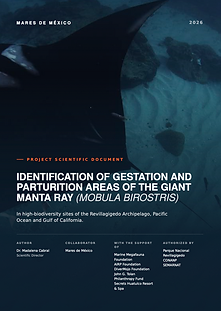
Identification of gestation and parturition areas of the Giant Manta Ray (Mobula birostris)

The project aims to discover key habitats used by pregnant females in the Revillagigedo Archipelago, Banderas Bay, and the Gulf of California. To achieve this, it will use satellite telemetry, underwater ultrasound, and laser photogrammetry.


Led by Dr. Madalena Cabral and supported by Mares de México, the study aims to deploy satellite tags on oceanic manta rays to track their movements, habitat use, and behavior. The data generated will help identify key areas for gestation and parturition and will be critical for informing conservation and management strategies, including protecting these habitats from threats such as bycatch and supporting the creation or adjustment of marine protected areas.

A collaboration between MMF and Mares de México

Roca Partida. PB. 4 - Alonso I. Rodríguez OW-1.jpg

Scientific article

Consult the full academic publication developed by the lead researcher of the project.

Objectives 1_edited.jpg
Aporta_edited_edited.png

Your contribution to this project will allow us to continue generating relevant scientific data to create better public policies and protect this species.

Some populations of giant manta rays around the world have declined by as much as 90%.

Classified as endangered (IUCN) and under special protection in Mexico (NOM-059-SEMARNAT-2010)

SOME RELEVANT RESULTS

Initial satellite data confirm giant manta ray migration corridors outside of Revillagigedo Park

Satellite tracking data indicate that giant oceanic manta rays tagged in Revillagigedo National Park undertake extensive movements beyond the park's boundaries, following key migratory corridors that connect the protected area with international waters, the French Exclusive Economic Zone around Clipperton Island, and important Mexican marine regions such as the Gulf of California and coastal areas of the mainland. Upon leaving the safety of the marine protected area (MPA), these rays frequently enter regions characterized by intense fishing activity, significantly increasing their risk of interaction with fisheries and bycatch. The identification of these migratory corridors highlights the urgent need for collaborative, transboundary management measures and conservation strategies to protect these critical routes and effectively safeguard this highly mobile and vulnerable species.

ALL MANTAS EVENTUALLY LEAVE THE PROTECTED NATURAL AREA; RUNNING THE RISK OF BECOMING VICTIMS OF BYCATCH.

Objectives 1_edited.jpg

TEAM AND COLLABORATORS

Madalena Cabral

Project Leader

Alonso I. Rodríguez

Photographer and documentary filmmaker

Camilo Thompson

Environmental lawyer

Identification of gestation and parturition areas of the Giant Manta Ray (Mobula birostris) in sites of high biodiversity value in the Revillagigedo Archipelago, Pacific Ocean and Gulf of California

General Objective


  • Generate scientific data on Mobula birostris.

  • Protect reproductive females.

  • Identify key areas (breeding, feeding and gestation zones) inside and outside the Revillagigedo National Park (PNR), in focused areas of the Gulf of California and in the Pacific Ocean.

Specific Objectives


  • Expand the database on the distribution, behavior, and population dynamics of the giant manta ray

  • Using non-invasive, contactless underwater ultrasound to support manta ray conservation

  • Identify critical habitats for pregnant females

  • Assess areas at risk of incidental capture and human threats

  • Generate information for management policies, protected areas, and specific regulations

Introduction


Giant manta rays (Mobula birostris) are among the most iconic and enigmatic species in the oceans, renowned not only for their imposing size but also for their essential role in maintaining the balance of marine ecosystems. Despite their ecological importance, their reproductive biology and the critical habitats they utilize during the most sensitive stages of their life cycle remain poorly understood, especially in the Eastern Pacific. Regions such as the Revillagigedo Archipelago, Banderas Bay, and the Gulf of California, considered global biodiversity hotspots, offer a unique setting for studying these marine giants and understanding the challenges they face from threats such as bycatch and human impact on their environments.


This project aims to fill these knowledge gaps by using non-invasive, contactless underwater ultrasound to support manta ray conservation, together with satellite telemetry and laser photogrammetry, which will allow researchers to identify gestation, nursery, and feeding areas used by pregnant females. With this information, the project seeks not only to advance the scientific understanding of the species but also to generate evidence that will contribute to the design of more effective conservation strategies, strengthening the protection of these vulnerable populations and promoting the sustainable management of Mexico's marine protected areas.

Justification:

Knowledge gaps

There is limited data on:

Breeding areas

Birthing sites

Distribution of pregnant females

Previous studies at sites such as Nusa Penida or Komodo indicate areas of reproductive use, but similar data are lacking for the Eastern Pacific

Threats :

Classified as endangered (IUCN) and under special protection in Mexico (NOM-059-SEMARNAT-2010).

Incidental catch (tuna purse-seine and gillnets)

Low reproductive rate (1 offspring every 4-5 years for this species)

Habitat degradation due to pollution, unregulated tourism, climate change and bycatch.

Ecological and Economic Importance

Keystone species in marine ecosystems:

Regulates zooplankton populations

Ecosystem health indicator

Important for diving tourism, generating significant income in Baja California Sur and Revillagigedo

Conserving it has implications for the blue economy and marine science in Mexico

Legal and Environmental Aspects.

It links principles of environmental law:

Precautionary

Sustainable development

Intergenerational equity

Scientific Methodologies and Techniques

Satellite Telemetry
Deployment of SPOT and miniPAT satellite tags

They are placed using titanium anchors and metal teathers while scuba diving.

MiniPATs store data about:

Location

Temperature

Depth

It allows the study of migratory routes, habitat use, and birthing areas.

Image 1. Tagging or placement of satellite technology for mobility monitoring.

Images 2 and 3. Satellite technology for mobility monitoring.

Underwater Ultrasound (Duo-Scan: Go Oceanic)

Portable, wireless, and waterproof ultrasound device

It allows you to detect:

Reproductive status

Fetal development

Non-invasive technique and no need for sedation

Real-time images on mobile devices

Goal: to perform 50 ultrasound exams

Image 4. Duo-Scan ultrasound equipment: Go Oceanic

Image 5. Data capture by diver and use of Duo-Scan ultrasound equipment: Go Oceanic

Laser Photogrammetry:

Two parallel lasers allow the wingspan of the blankets to be estimated.

Useful for:

Determine sexual maturity (in females 4 m wingspan)

Identifying individuals by unique ventral spot pattern (photo-ID)

Goal: 50 photogrammetric samples

Image 6. 4K audiovisual camera and two laser measurement modules.

Image 7. Measurement model applied to target species.

Image 8. Natural markings that are digitized by laser and yield specific signs to identify each individual.

Study Sites:
Archipiélago de Revillagigedo (PNR)

Islote La Reina

Isla Cerralvo

Bahía de La Ventana

Ensenada de Muertos

Archipiélago Espíritu Santo

Isla San José, El Pardito, Isla San Francisquito

Image 9. Site map of implementation of scientific methods for monitoring Mobula birostris by satellite tagging, photo ID and ultrasound samples.

Expected Results
Identify critical areas for gestation and parturition
Generate data to support:

Expansions of protected areas

Specific fishing regulations

To contribute scientific knowledge about:

Reproductive cycles

Marine connectivity

Population dynamics of the giant manta ray

Reducing anthropogenic threats and strengthening the conservation of this emblematic species

Academic and Dissemination Relevance

Project supported by top-level researchers and international organizations

Generation of scientific publications

Visual outreach material:

Videos

Underwater photographs

Demonstrative laser photogrammetry

Objetivos 1_edited.jpg
THIS PROJECT IS POSSIBLE THANKS TO THE SUPPORT OF
Fund_edited.png
Objectives 1_edited.jpg

#APORTATUGRANITODEARENA

Click and make waves with us

Mares de México

  • Instagram
  • Facebook
  • TikTok
bottom of page