


02. Magdalena Bay
Alonso I. Rodríguez de la Parra, explorer and documentary filmmaker.
"With patience, your moment will come."

Magdalena Bay
Sailing in Magdalena Bay can evoke a wide range of emotions. As we know, the ocean is not a zoo; nothing can be taken for granted. On one day, you might have hundreds of encounters, while on another, you may see nothing at all. Whenever I venture out to sea, I carry no expectations. Most of the time, I am simply grateful for the opportunity to witness a new sunrise.
Yes, sunrises are the natural events I enjoy the most. I can confidently say that 99% of them are beautiful. Simply witnessing that light painting everything around us with magical colors is enough to fill you with joy. And when you add the experience of heading out to sea, feeling the breeze and the water being cut by the bow of the boat, that alone is reason enough to feel grateful.
It is light that makes all of this possible.

When you go out into the ocean without expectations, there will always be something that surprises you. And many times, what has impacted me the most is simply being on the boat, contemplating the landscape or waiting for something to happen. That waiting time leads you to reflect on thoughts that align many existential questions. These thoughts arrive with the breeze, free from the distractions of a phone, since most of the time there is no signal. These are moments I deeply value.
It is like entering a form of meditation, where the ocean gives you the answers you need to heal different aspects of your life. I believe this is something many of us who regularly go out to sea can relate to. The ocean opens our minds and allows us to think more clearly. There is something about it that makes us more sensitive; its vastness reminds us how small we truly are.

The bay stretches for approximately 50 kilometers along the western coast of Baja California Sur, protected by the sandy barrier islands of Magdalena and Margarita. It is part of the municipality of Comondú and is mainly visited due to the migration of gray whales, a spectacle I have not yet had the privilege to witness. These majestic creatures arrive in winter to reproduce.
Although I am not personally drawn to fishing, this area is frequented by many sport fishermen. However, I do not fully agree with this practice, as in recent years it has been shown that more sustainable tourism, such as wildlife watching, can bring far greater benefits to the region than extractive activities. From my first visit to my most recent one, I have noticed a significant increase in fishing boats and a decline, and even migration, of species to less crowded areas.
Without a doubt, wildlife watching tourism can be extremely beneficial for the region if we continue to regulate it, promote good practices, and most importantly, instill in those who join us on these expeditions a culture of well-being and a healthy relationship with the environment and the ocean.

Throughout the year, different species can be spotted in this area. I dare say that all of Baja California is truly a paradise for biodiversity. As a society, we should be more aware of the need to care more deeply for the places we interact with, whether as tourists, service providers, or fishermen. But even more importantly, we must recognize that even if we are not physically present in these places, everything is connected, and our actions at home also have an impact on places like this.
That is why it is essential that when we visit these natural sanctuaries, we not only take memories with us, but also stories that we can share with others. But above all, we must convey the importance of what exists beyond what we can see, in those natural spaces that not many people have the opportunity to experience.


I firmly believe that all species, including humans, have a greater purpose in life and are capable of communicating far beyond what our eyes can see or our words can express. There is a type of communication that is rarely spoken about, one that is more connected to feeling than to understanding. When nature presents itself to us, it goes far beyond mere luck; countless factors align for you to be in the right place at the right time.
I know many people who have visited these places and never experienced a meaningful encounter. That is why I deeply appreciate even the opportunity to observe smaller species that may not be as celebrated as larger ones. You can call me romantic or whatever you like, but I firmly believe that every species has something to teach us. Lessons are everywhere if you are willing to look, but most importantly, if you are open to feel.

Each autumn, the currents of the Pacific Ocean bring the famous bait balls of sardines or mackerel, creating a mesmerizing natural spectacle. Watching these schools of fish move in what feels like an underwater ballet is like witnessing a perfectly orchestrated symphony with unpredictable variations. These formations create shapes in the water that, with a bit of imagination, can resemble almost anything. It feels similar to when we were children looking for shapes in the clouds. It is the power of cooperation and interdependence in nature. Sometimes it seems that we humans are the only ones out of sync with everything else that exists.
These bait balls attract hundreds of species and bring abundance and life to these waters. Among them are orcas, whales, marlins, tuna, dorado, sharks, sea lions, dolphins, as well as biologists, tourists, and even influencers. It is fascinating how a species that is rarely talked about can generate an entire chain of interactions and connections that go far beyond simply being there. For us, it becomes a memory that lasts a lifetime.

The striped marlin is one of the most beautiful fish I have ever had the privilege of witnessing in the water. It moves with incredible precision and elegance, making it the fastest fish in the ocean. Watching it glide through the water is something that stays with me forever, not only as an image but as a feeling, an indescribable energy.

They have a level of control over their bodies that reflects astonishing precision. It makes me think that if a marlin wanted to, it could easily injure any of us. There are records of fishermen being pierced by their bills when marlins leap toward the boat while hooked. However, marlins are not aggressive toward humans. If you keep your distance, they approach out of curiosity, circle around, and then return to the bait ball to feed.
Kajikia audax is the scientific name given to this magnificent animal, which often moves in groups of hundreds.

Seeing one or seeing a hundred of these animals is a gift from nature. While these photos capture a unique and unrepeatable moment, if we protect this ecosystem, we will continue to witness them in these waters. Every encounter is different, and having expectations is fine, as long as they are directed toward the right mindset. In nature, I would say: expect little, and you will find that what you receive is more than enough.
We need to slow down, take a deep breath, and realize that we are losing our connection with nature. That is why so many people long for experiences like this. But beyond feeding that desire to explore, we should also find ways to bring nature back into the places where we live. I know many will not do it because it involves risk, but I hope these images inspire us to restore nature within our cities. And that begins with us acting naturally, consciously, and with presence.
I am deeply grateful that my work has taken me to incredible places and has allowed me to return each time with a new purpose.

Another species that visits this area is the mobula ray. These animals move in large groups, although they can also be seen alone. The group shown in the image above was swimming in a teardrop formation, something that struck me as particularly beautiful. In that moment, I found myself reflecting on the importance of water in our existence. These thoughts may seem obvious at first, but when you dive deeper, what I felt while observing them was an invitation to reflect on the significance of a single drop.
It only takes one drop of water for all of this to exist, and when two drops meet, they become one. Just like us.


Megaptera novaeangliae / Admiration - Alonso I. Rodríguez de la Parra
On one occasion, while observing a bait ball, we could hear whale songs coming from all directions. We never saw them, but we could feel the powerful energy of their presence in the distance. It was the most beautiful symphony I have ever heard. Even now, listening to the recordings takes me back, but the feeling remains beyond sound.
I am working on something so we can all experience it.
In Mexico, it is illegal to swim with any species of whale. The image above was captured from the boat using a pole cam, a tool we often use in our expeditions. It allows us to film without entering the water. Sometimes, it is better to simply enjoy the moment from the boat, watching their silhouettes or listening from a distance. I will be honest, when I was younger, I would swim toward whales whenever I saw them, and I have had incredible encounters, including one in Oaxaca while filming turtles. I will share that story another time.
I know other photographers who have filmed whales feeding on bait balls without knowing what would happen next. A massive whale can suddenly emerge from the deep. That is why it is essential to be cautious, keep a safe distance, and always follow the guidance of local experts. The captain is always in charge.
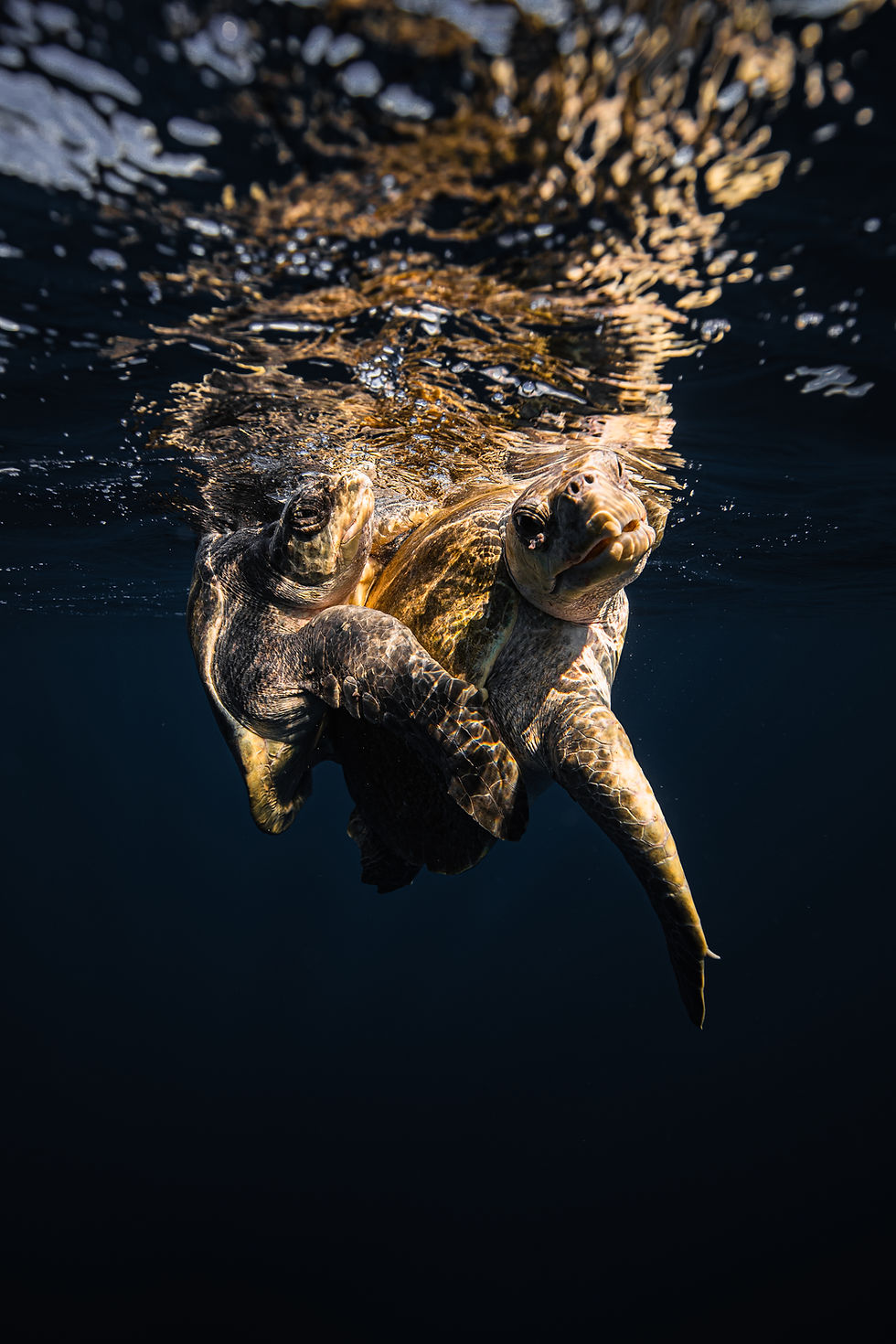
So it does not matter if it is a turtle, a squid, a mobula, an orca, a bait ball, a marlin, or simply a beautiful sunrise. You must understand that life will give you what you need, not always what you want. Have healthy expectations, but above all, be patient.


Sardines pressing in / Navigating between worlds / Guardians of the abyss - Alonso I. Rodríguez de la Parra
“I believe that all species, including humans, have a greater purpose in this life, and that we are capable of communicating far beyond what our eyes can see or what our words can express. There is a kind of communication that is rarely understood or spoken about, one that is far more connected to feeling than to understanding.”
Alonso I. Rodríguez de la Parra


Comments