


01. Reserva de la Biósfera Banco Chinchorro
Updated: Apr 22
Alonso I. Rodríguez de la Parra, explorer and documentary filmmaker.
"It was in nature where I found myself and my passion"

"Banco Chinchorro Biosphere Reserve, July 2018.
Today, December 26, 2022, I look back with a new perspective. I have found great joy in everything I do, but photography is what truly fuels my spirit and gives renewed purpose to my days. What began as a simple hobby has evolved into a true calling, although I have yet to develop the discipline needed to fully make the most of my experiences. Through these words, I seek to reconnect with the passion that photography once awakened in me. More and more, I realize the power an image or video can hold, as long as it is supported by a compelling story.”
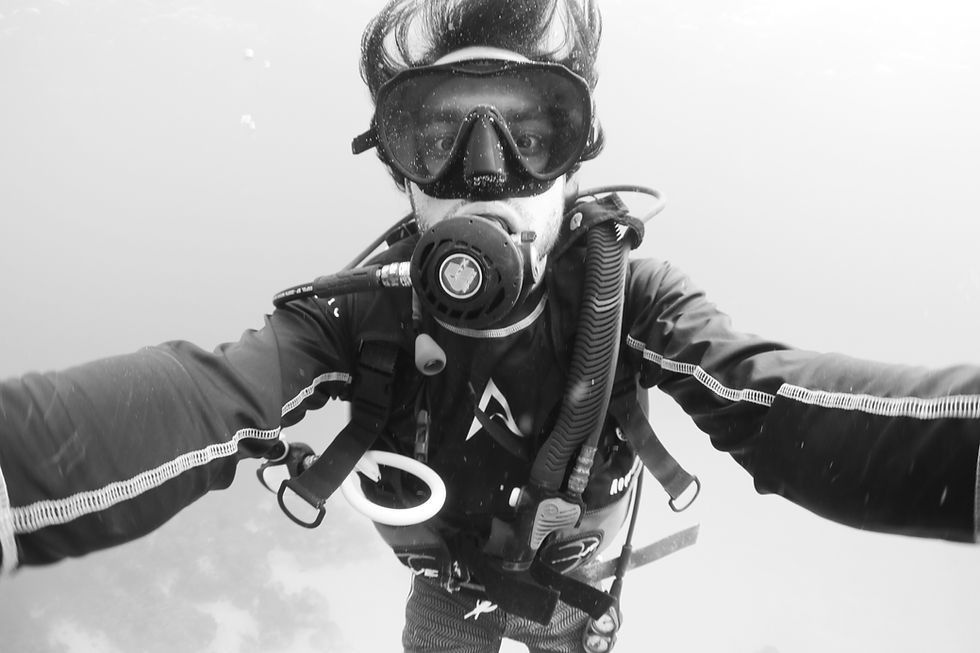
The story begins with my first camera, a Canon 1DX Mark II, a faithful companion that has joined me on every adventure to this day, including underwater explorations in the seas of Mexico. I could never have imagined the magnitude of what I would witness through its lens, nor the profound impact those images would have on my life.
In July 2018, I embarked on my first journey as a professional photographer. I flew from Mexico City to Chetumal, Quintana Roo, and from there traveled two and a half hours by road to one of the most special places on Earth: Xcalak. This small coastal town, with fewer than 500 inhabitants, lies so far south that it marks the natural border with Belize. Although Xcalak was not our final destination, it was the starting point of our real journey. We spent a peaceful night there, unaware that what awaited us would forever change my perception of nature and the species that inhabit it.

Three hours by boat from Xcalak lies Banco Chinchorro, the largest atoll in Mexico and one of the most important in the world. What was once a volcanic crater has become a remarkable ecosystem, protected by a ring of coral. Since being declared a biosphere reserve in 1996, access has been regulated to preserve its extraordinary biodiversity. Here, corals, algae, mollusks, rays, turtles, sponges, dolphins, and a vast array of fish coexist. It is also one of the few places where you can come face to face with what feels like a living relic of the Jurassic era: the crocodile.
Upon arrival, I was overwhelmed by the colors, crystal-clear blues blending with the greens of the mangroves, accompanied by warm tones beneath the water. The fishermen’s huts, elevated on wooden platforms, seemed to float above the sea. But the most intense moment was yet to come. We began preparing bait using lionfish to attract the crocodiles. With each strike of the knife against the wood, we knew they would come, drawn by the easy feast. And they did.
The American crocodile, found from southern Florida to Central America, is a species at risk. It can reach up to five meters in length and weigh around 500 kilograms. Despite its imposing presence, its diet mainly consists of small prey. Its role in the ecosystem is vital, and its presence is a sign of a healthy environment. However, its apparent proximity to certain areas is not a sign of population growth, but rather an indication that urbanization is encroaching on its habitat.

Scientifically known as Crocodylus acutus, this majestic reptile is distinguished by its sharp and powerful morphology. Capable of reaching speeds of up to 32 km per hour, and equipped with impressive strength in both its jaws and body, the American crocodile is truly a marvel of nature.Despite these qualities, its diet mainly consists of small prey, and it rarely hunts large mammals. However, its role in the ecosystem is crucial, and its presence is an indicator of a healthy environment.That said, we should not fall into the false assumption that its apparent abundance in certain areas reflects population growth. Rather, it is a sign that urbanization is encroaching upon the habitats where this magnificent animal lives.
As a result, it is essential that we find new ways to interact and coexist with nature, preserving the delicate balance of our environment.
Entering the water with such a creature was not easy for me. Outwardly I tried to remain calm, but inside I felt a deep respect. I prepared my camera and submerged myself.
The first moments were pure adrenaline. But when I locked eyes with the first crocodile, everything changed. I felt a profound connection with the moment, with nature, and with myself. For a brief instant, I lowered my camera and simply experienced it. In that moment, I understood what I wanted to do with my life: reconnect with nature and inspire others to do the same.

I let myself be carried by the flow of time, capturing countless photographs from every possible angle. The crocodiles, creatures that seemed to lack any visible facial expression, at least from my perspective at that moment, remained still and unpredictable. They approached me with an unsettling slowness, and just as they seemed about to collide with me, they would suddenly stop, making no further movement, simply remaining there, frozen in front of me. It was as if they were measuring my reaction or engaging in a silent exchange of gazes. It was clear that if I lost my composure or showed even the slightest hint of fear, I would be the one at a disadvantage in that situation.
Before I knew it, the sun was beginning to set on the horizon, and I was still immersed in the water alongside these imposing creatures. I never imagined I would spend so much time in the water, surrounded by crocodiles. Yes, surrounded. There was a long stretch of time when more than five of these majestic reptiles were around me, along with other photographers. Staying alert and protecting my back depended entirely on trusting those behind me, making sure everything remained under control, just as I was doing on my end.

The lessons I gained from this experience stay with me in my daily life. There were many things that used to fill me with fear, and after this, I was able to break those paradigms and feel free and strong. I am now able to not judge by appearances, while understanding the importance of respecting those in front of us. Without a doubt, the animal I fear the most on this planet is the human being. Humans tend to destroy what they do not understand or what they fear.
To you who have experienced this, I invite you to change the way you see the world, to be more empathetic, and to realize that without the natural world, we are nothing. Life itself is the greatest teacher, and the beings that inhabit it are here to guide us. They are not here to serve us; we are here to serve the planet.



Comments