


TIMSHEL: FROM CASE FILES TO THE EYES OF A PREGNANT MANTA
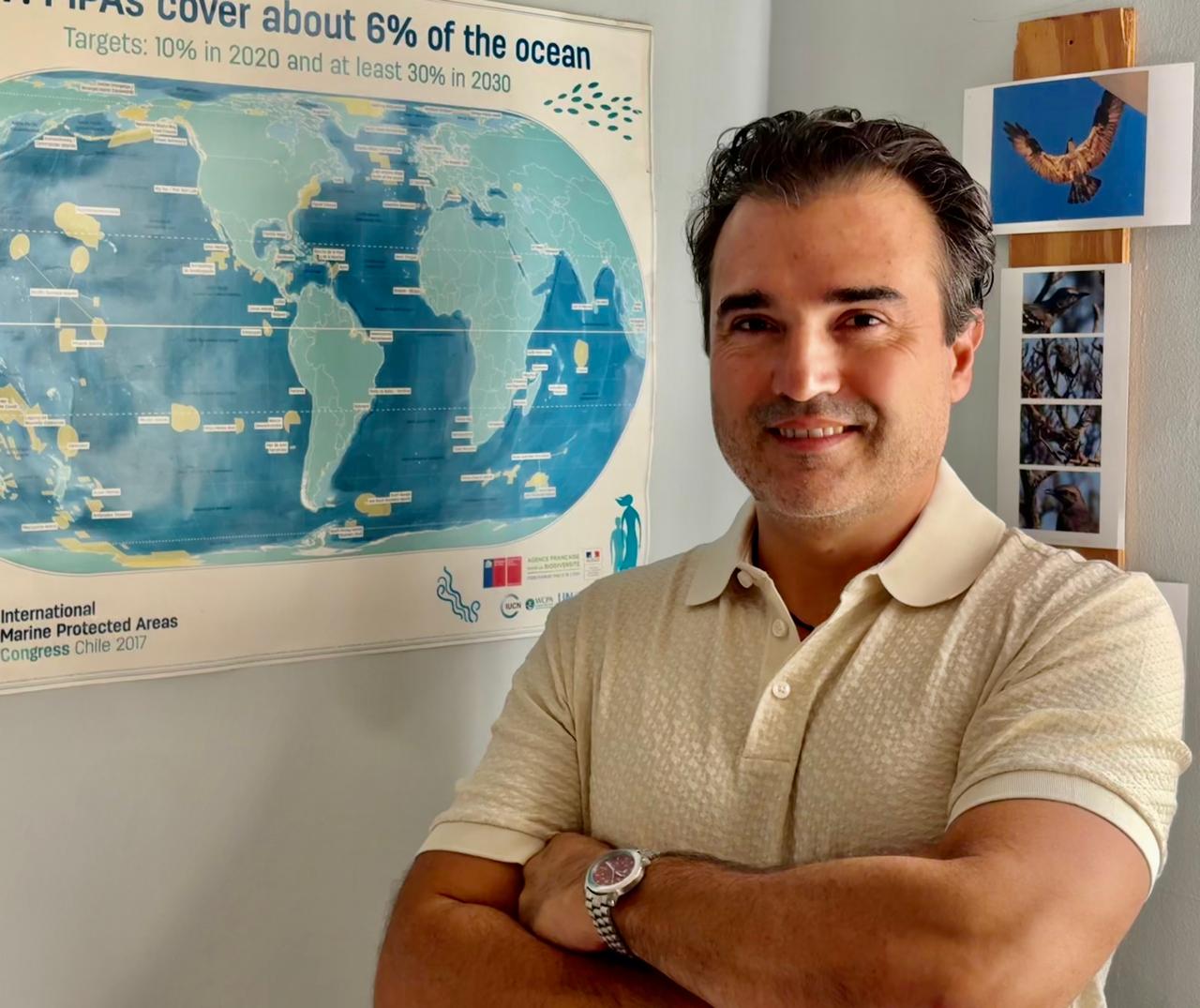
By Daniel Camilo Thompson Póo, Environmental Attorney
THE ORIGIN: legal justification, bureaucracy, and an ideal permit
It didn't start at sea. It started in an office. In front of a computer. Building a project that could convince biologists, lawyers, and authorities. Over a year ago, Dr. Madalena Cabral "Lena" asked for my help. She needed to legally structure an idea that already had a heart: to identify gestation, nursery, and feeding areas for the giant manta ray in Revillagigedo and the Baja California Peninsula.

Why is this a priority? Mantas give birth to a single pup every two to five years. Low reproductive rate. High vulnerability. That's why the IUCN lists them as endangered, and why NOM-059 classifies them under "Special Protection." But this isn't just a legal obligation. It's environmental justice: acting in the face of risk and ensuring that future generations inherit an ocean with mantas.
The invisible work. Preparing the expedition was a labor of precision. Lena and everyone in the cooperation put their hearts into it. My role was the legal management and justification. But to operate in Revillagigedo, we needed much more than a good project:
Scientific collection permit
Temporary import permit
Credentials for each volunteer
The 68-foot sailboat Timshel, its ownership documents, insurance, and certifications
Positioning systems and satellite communications
Permits from the National Park Directorate
We all had a role. Crew members. Science divers. Experts. Documentation volunteers. And I, in addition to being a volunteer, took on safety and regulatory compliance.
The scientific permit. The General Directorate of Wildlife (DGVS) reviewed every section of the project. Their conclusion when granting the permit was key: "The deployment of satellite transmitters is a minimally invasive procedure. You are not extracting any part of the species." They authorized the use of "materials, equipment, processes, methods, or alternative technologies." In other words: we can use underwater ultrasound to identify pregnant mantas. Technology is not a luxury. It is a necessity.
The resolution arrived on November 7, 2025. Its complement came just days before setting sail. It wasn't a traditional scientific collection permit. It was a pioneering permit: monitor without extracting, protect without possessing. We had the paperwork. We had the Timshel. We had the crew, the insurance, the certifications, and the technology. And we had a mission.
But the best was yet to come...
THE VOYAGE: ONE SAILBOAT, FOUR NATIONALITIES, AND THE PACIFIC
Five hours after casting off, the ocean welcomed us like an old friend. Orcas passed 200 meters away, heading straight for the Archipelago. Then two humpback whales showed their backs, their fins, their tails. As if to say, "Follow us." A pod of pantropical spotted dolphins began playing at the bow of the Timshel and stayed with us for many miles.

Captain John Beltramo bought the boat as a metal shell and rebuilt it with his own hands. On board were six crew members, two dive guides, three marine biologists, and one attorney — all of them divers. Four nationalities. One obsession: finding pregnant mantas.
We arrived at San Benedicto at night. At dawn, I saw the Bárcena volcano with its twin craters and the silhouette of a sleeping woman carved into the island's west face. "That's the Sleeping Woman," Mau told me. "At the end of her hair is Roca Manta."
THE FIRST DIVES: dozens of sharks and one very large manta
We descended at "El Cañon" to 20 or 25 meters. I had never seen so many sharks together: Galapagos, silky, hammerheads, whitetips and blacktips. It felt like being inside a documentary, but without the screen.

At "El Boiler" — the most famous dive site on San Benedicto — something happened I will never forget. I didn't know that on that volcano, beside the stone woman, a manta was waiting for me — a manta that would change how I understand justice. And then she appeared. We called her "Abuelita" (Little Grandmother). She was imposing, with scars on her eyes and her body marked by remoras. But what struck me wasn't her size. It was her gaze. She approached. She slowed her wingbeats. She looked directly at me through my mask while Lena performed the ultrasound on her upper left side. "We're here to protect you," I wanted to say. But instead, only a great energy of connection emerged — and a few bubbles. She moved the muscles around her eye. As if she understood.
I didn't know it then, but that manta already had a name. Timshel. And she also had a surprise inside.
THE SCIENTIFIC CONFIRMATION: a dawn I will never forget
Lena had been insisting: "Abuelita is pregnant." But some had doubts. Alisa Newton, an ultrasound specialist in pelagic species, was more cautious. We needed proof.
In the early morning of January 18, everything changed. It was 3:20 a.m. Lena woke me. Her voice was trembling. "Camilo! I've identified a manta with her baby. I swear to God, she's pregnant!"

I didn't react quickly. I'm a heavy sleeper. She kept talking to herself in the kitchen, comparing the ultrasound images with a paper from the Aquarium of Japan. "The mouth, Camilo. The wing folded upward. It's identical!" I got up and went to the kitchen. Lena showed me the phone with shaking hands. She kept repeating: "I know it, she's pregnant." And she was right. The fetus was moving its mouth, pumping uterine fluid through its gills. That tiny thing, inside that enormous manta, was alive and breathing. The noise woke Tim and Dr. Newton. Tim said, "Poor of her, she can't sleep well." But no one went back to sleep that night.
We had confirmed what we suspected. Mobula birostris, the giant Pacific oceanic manta ray, an endangered species, was gestating inside Revillagigedo National Park. And "Abuelita" was no longer just an old, wise manta. She was Timshel. And she is a mom.
THE BIG QUESTION: Where do mantas give birth?
But science isn't satisfied with just one answer. We know that mantas come to Revillagigedo to mate, feed, visit cleaning stations — and now we know they arrive pregnant. They spend months there. But giving birth is something else. Giving birth in the open ocean is an act of vulnerability. It's likely that pregnant females migrate hundreds of miles to calmer waters — warmer waters, with fewer predators.
Where do mantas give birth? That is the question that drives us. That's why Lena attached a satellite transmitter to Timshel. That's why in March 2026 she returned, aboard a liveaboard, and found three more pregnant females. Two of them — "Ophelia" and "Grecia" — were also tagged.
On that expedition came Alonso Rodríguez de la Parra, founder of Cuidando los Mares de México. Not just to document every dive, every fetal wing on the ultrasound. He came to continue the satellite tagging, to hold the camera where science meets wonder, to support Lena in every decision. Alonso knows that protecting an endangered species isn't done from a desk. It's done in the water, with a tank on your back and your eyes fixed on the horizon.

From June to August of this year, we will begin receiving the data. Six months of movements, depths, routes. Some mantas will stay inside the park. Others will cross into international waters, toward Clipperton Island, into the deep Pacific. If they leave the protected area, that is exactly what we need to know — so we can expand protection, justify new regulations, and tell SEMARNAT, CONANP, fishers, and shipping lines: "Here are the corridors. Here they give birth. Here we must manage and protect."
The giant manta ray is protected by law; its fishing is prohibited. But outside the Revillagigedo polygon, the sea is vast, and enforcement is thin. Incidental catch in ghost nets and gillnets continues to kill mantas. Our data won't change that overnight. But it adds to the collective effort. As an attorney, I know that without evidence, there is no case. As a conservationist, I know that without heart, there is no movement. Mantas need both.
TIMSHEL – FREE WILL, THE LIFE OF THE VOLCANO, AND PERSEVERANCE
Timshel means "thou mayest." In its deepest root lies free will: the capacity to choose our own path. That night, in the boat's kitchen, Lena chose to trust her images when everyone doubted. Captain Beltramo chose to rebuild that boat so that science could reach Revillagigedo. And I chose not to give up in the face of precautionary notices, cross-filed notifications, and administrative silences. Perseverance sometimes dresses itself in a legal brief, sometimes in a scream at 3:20 in the morning.


Out there, in the distance of the Bárcena volcano, life continues as it did centuries ago. Among the cliffs of black rock forged by lava and wind, waves crash with great roars that echo against the sailboat's hull. The red-billed tropicbirds — white birds with endless tails — fly over the sunset with calls that bounce off the island's walls and return to us like an ancestral echo. Frigatebirds glide without moving their wings. The juvenile blue-footed boobies, still brown without their red feet, fight for a spot on the bow. And beneath the surface, the megafauna continues its dance: hammerhead sharks passing in formation, mantas turning like enormous shadows, schools of crevalle jacks making the water sparkle.
This place is not just a national park. It is a reminder that the ocean can be whole when we let it be.
Now comes the most important part: for the data to arrive. For us to learn where mantas give birth. To protect them where they live, where they gestate, and where they give birth.
And hopefully, the children of today will be able to swim alongside a manta and hear, through their masks, the most beautiful silence in the sea.

Daniel Camilo Thompson Póo
Environmental, Maritime, and Conservation Attorney | Consultant, Cuidando los Mares de México A.C.
Aboard the Timshel, somewhere in the Pacific of Mexico…

Comments